



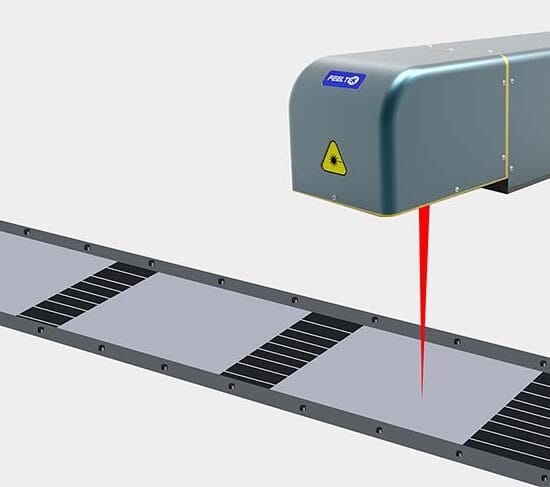

Production Line Laser Marking Machine (Laser Jet Printer – Fly Laser) – MOJET
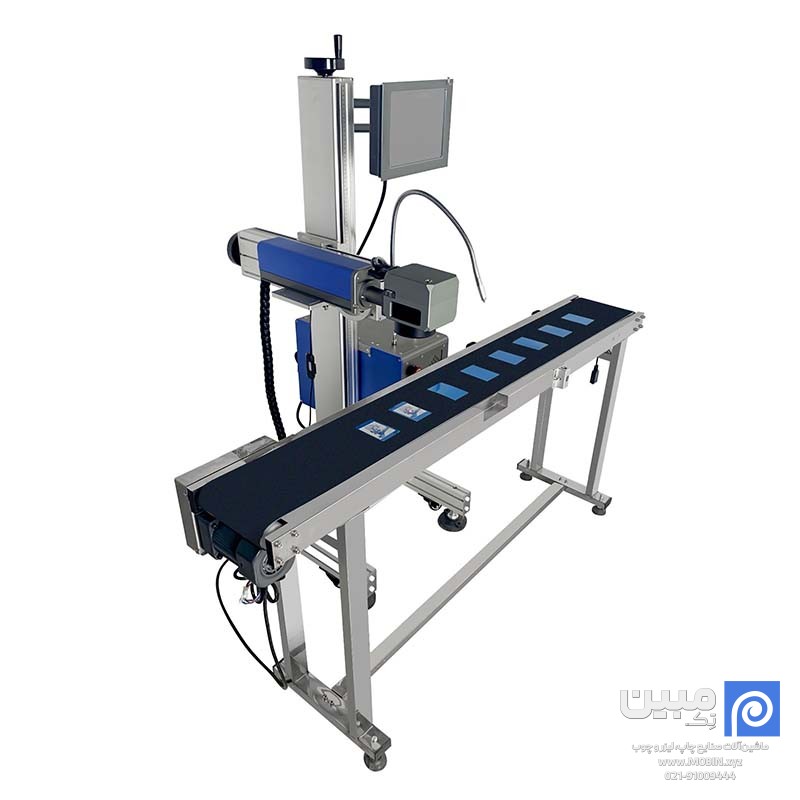
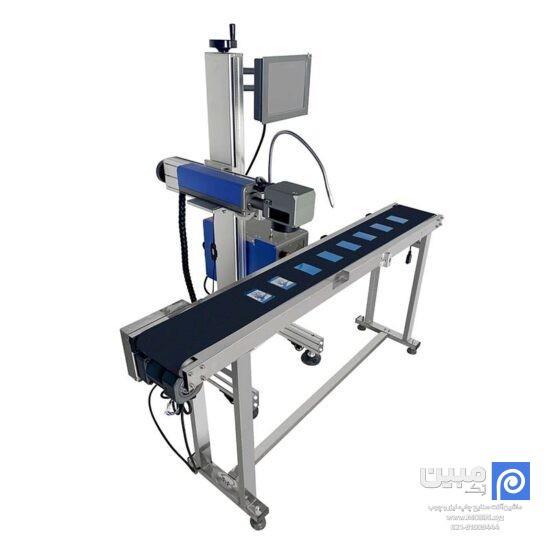
The production line laser marking machine, combined with a conveyor belt, allows for automatic positioning and continuous marking of products without the need for human intervention, which leads to a significant increase in productivity. You can watch videos of this device below.
Types of laser marking machines in production lines:
- Fiber marking: Suitable for all opaque metallic and non-metallic materials
- CO2 marking: suitable for transparent materials
- UV marking: suitable for highly temperature-sensitive materials
You can use the production line laser marking machine (fly laser or jet laser) Buy in installments. [Installment purchase conditions]
Related products



Special sale!


Description
📅 Content updated on: 14/04/2020
What is a production line laser marking machine (Fly Laser - Laser Jet Printer)?
The production line laser marking machine or laser jet printer, combined with a conveyor belt, allows for automatic positioning and continuous marking of products without the need for human intervention, which leads to a significant increase in productivity.
The laser jet printer is designed for mass production environments and is suitable for all kinds of parts, tools, crafts, pens, knives, labels, wires and tags on the assembly line. This system uses production line operation technology and industrial automation to provide high speed and integration, so that no additional labor is required and the production cycle time is effectively shortened.
The on-line laser engraving system has powerful text and graphic marking capabilities, and automatically generates serial numbers and batch numbers to identify and track products. Especially in scenarios that require high-speed and dynamic marking, such as continuous production lines, the system enables efficient and uninterrupted marking operations, thereby further improving work efficiency and product quality.
Laser machine Production line marking (Fly Laser – Laser Jet Printer) How does it work?
- Layout and loading of parts:
First, the parts to be marked are placed neatly on a conveyor belt. In some cases, this process is replaced by an automatic feeding system to minimize manual intervention. - System setup and calibration:
Before starting work, the marking control system performs a series of initial settings. These settings include adjusting the laser parameters and calibrating the vision system to ensure the accuracy and quality of the marking. - Automatic transmission:
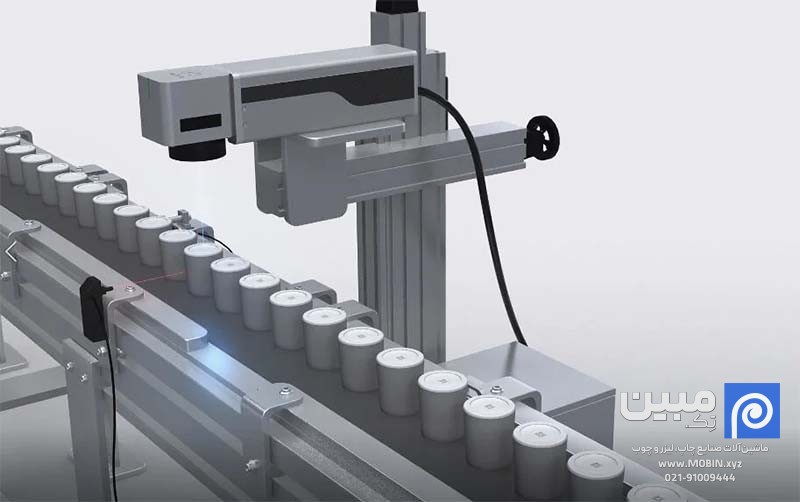
As the conveyor belt starts moving, the parts are sequentially moved to the predetermined positions for marking. At this stage, the speed and accuracy of the conveyor belt positioning are very important so that each product reaches the marking area at the right time. - Marking while moving:
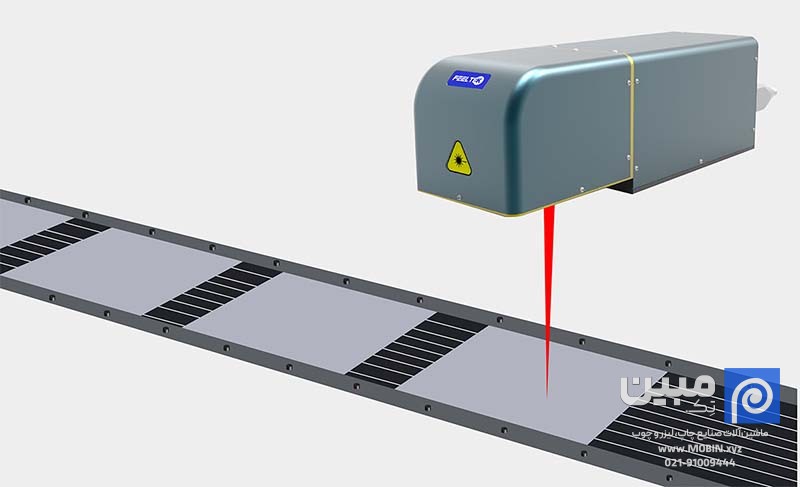
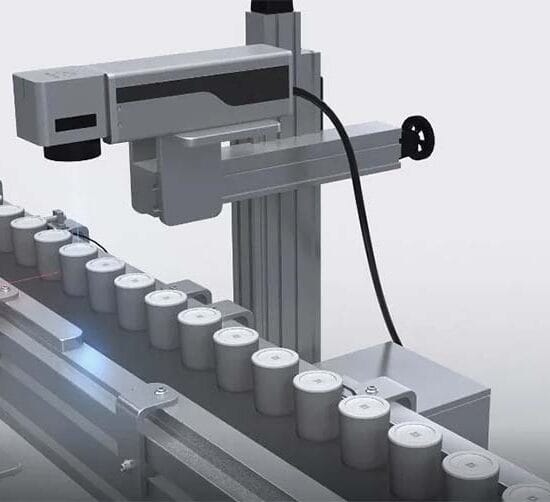
When the part reaches the specified position, the fiber laser marking machine is quickly activated and, based on the precise coordinates provided by the vision system, marks the part with high precision. Thanks to the high speed and efficiency of the fiber laser, this process is carried out very quickly, as if the marking is “on the fly”! - Automatic unloading and transfer to the next process:
After marking is completed, the conveyor belt moves the parts to the next station, which may include inspection, packaging, or other processes. The entire process is carried out seamlessly, significantly increasing production efficiency.
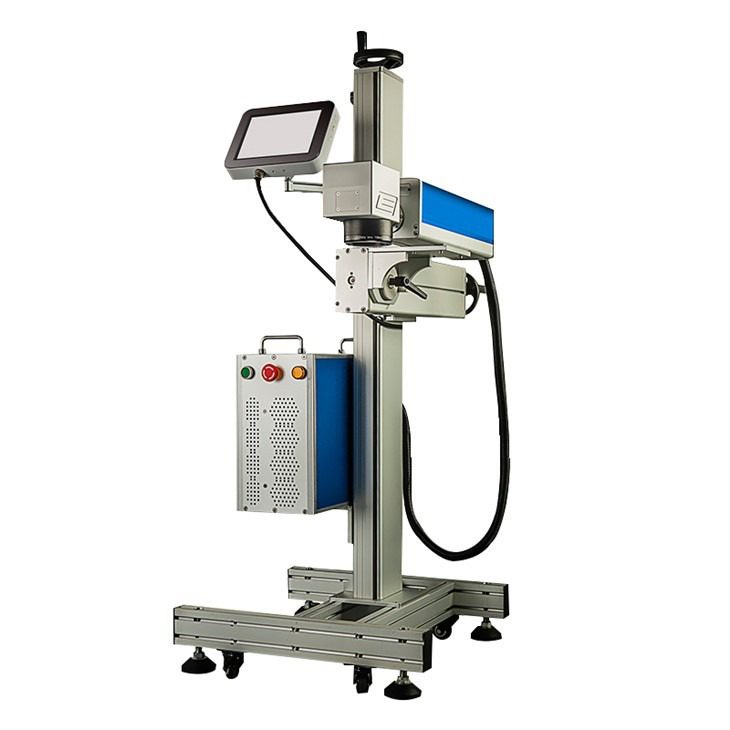
Components of laser marking machine production line
- Control system:
This section acts as the command center of the machine, managing the marking tasks, precise control of the laser and scanning head. It also implements the monitoring and troubleshooting system to ensure the stable operation of the machine by cooperating with the computer, laser control card and motion control card. - Laser source:
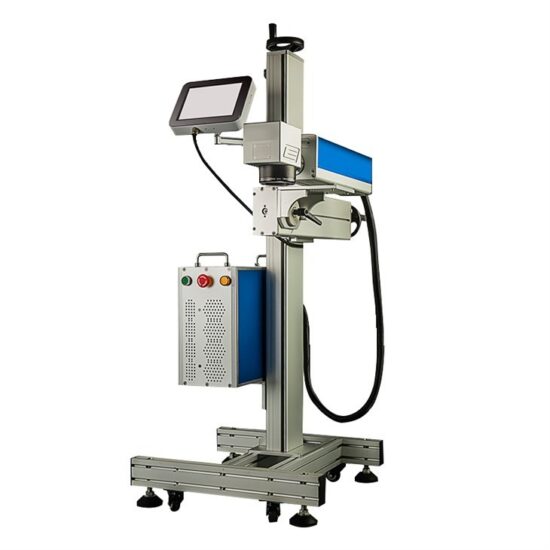
The laser generator converts the high energy of the laser into a usable laser beam for marking. Common types of lasers include CO2 lasers, fiber lasers, and UV lasers. Since each type of laser has its own characteristics and applications, users can choose the right type of laser based on their needs. - Galvanometric scan head:
The galvanometric scanning head is responsible for the precise guidance and movement of the laser beam. This section uses a set of mirrors to control the path and speed of the beam, and with the ability to autofocus and dynamic marking while moving, it can mark on various parts with high precision. - Conveyor belt:
The conveyor belt is responsible for transporting materials and makes the parts move at high speed along the designated path, and the processing process is continuous and high-speed. This section is equipped with automatic sorting, positioning and precise alignment capabilities to ensure high efficiency and low error rate in mass production. The conveyor belt is a separate piece of Fiber marking machine It must be ordered separately.
Flexible and reliable production solutions for on-line laser marking
- A. Increasing production efficiency
The laser marking system on the production line has the ability to quickly track moving parts and is compatible with the high speed of products on the conveyor. Thanks to advanced real-time positioning and tracking technology, the laser beam can accurately follow the moving path of the part and perform precise marking. No matter how fast the products move on the conveyor (within the standard range); this system maintains consistent marking quality and provides high efficiency. - B. Product quality assurance
Using high-speed laser scanning technology, this system is capable of completing complex marking tasks in a very short time. The high marking speed meets the needs of mass production lines and significantly increases productivity. The laser marking system can continuously and accurately engrave characters, numbers, production serial numbers, production dates, logos, and even complex patterns and anti-counterfeiting marks on a variety of materials. With programmed control, it greatly reduces the need for manual intervention, resulting in fewer human errors. - C. Suitable for various materials
Laser marking has a wide range of applications on the production line and can easily process products made of various materials. Whether it is metal, plastic, glass, ceramics or high-hardness materials, this system performs marking with high precision.
Visual positioning system in laser marking machine on production line
Marking while moving It is an advanced laser technology that is ideal for high-speed, high-precision marking needs in industrial manufacturing. It mounts a laser marking head on a robotic arm or high-speed conveyor belt to perform precise marking while the part is moving. One of the key advantages of this technology is its close integration with visual positioning systems.
Visual positioning system It is able to record and analyze the position, direction and other information of the part in real time. Even if the parts are irregularly positioned or moving, this system quickly and accurately identifies the marking position and guides the laser head to perform precise path and focus. This ensures that the marking accuracy is not affected by the movement of the part.
Benefits of visual positioning:
- Precise positioning:
For parts that are not in fixed positions or are randomly arranged, the vision system automatically detects and positions them. This capability minimizes the need for manual adjustments and increases flexibility and automation. When parts are irregular or small, the system can use CCD cameras to identify key points in real time and optimize the marking process. - Increased accuracy:
For small or complex-shaped parts, the vision system uses precise algorithms to perform micron-level positioning. This high accuracy ensures marking quality and improves the quality of the final product. - Improved performance:
Laser marking machines with CCD vision systems can mark multiple parts simultaneously. This process, with automatic loading into production lines and visual positioning, reduces labor and significantly increases productivity. It also prevents errors and is easily adjustable for production lines with a variety of products. - Cost reduction:
By automating the process, there is less dependence on human labor, which reduces labor costs. Also, due to the reduction of human errors, production waste is minimized, significantly reducing production costs in the long run. - High adaptability:
This system allows the user to easily adapt to different product designs and input and edit designs, texts, serial numbers and marking patterns with a simple process. The marking content is easily customizable and covers a variety of marking needs. Whether in standard mass production or small-scale customized production, this technology will easily meet the needs of different industries and products.
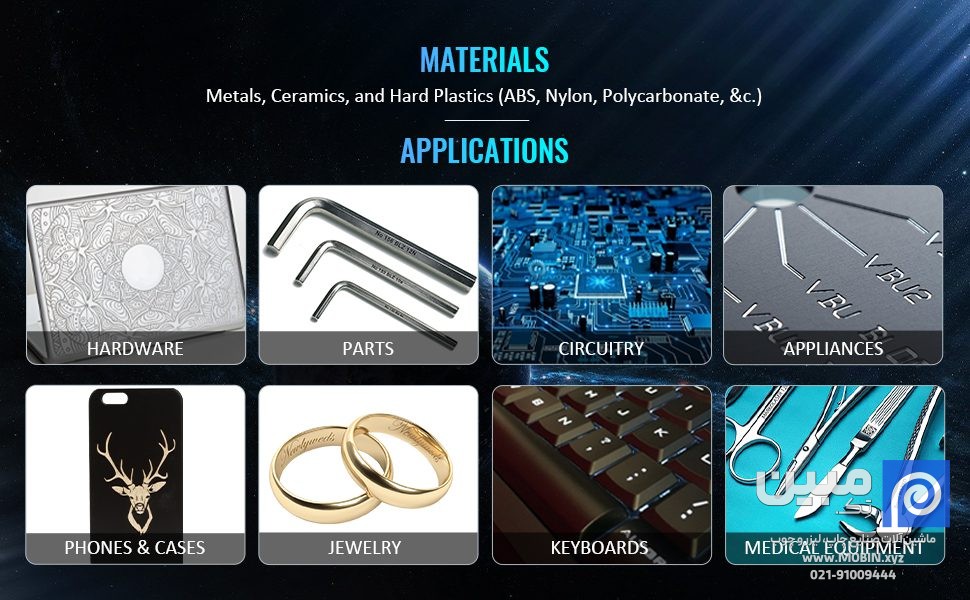
Applications of industrial online laser marking machine
Production line laser marking machines (fly lasers) play an important role in production lines in various industries. These machines are used to mark serial numbers and identification codes of electronic components, insert production dates on food, pharmaceutical and cosmetic products, as well as mark metal and non-metal parts in the automotive and other industries.
Industries and Applications:
- Automotive and mechanical industry:
Marking parts such as bearings, steel bushings, piston rings, car engines, vehicle identification plates, and machine tools. - Electronics and communications industry:
Suitable for marking mobile phones, keyboards, electronic components, home appliance panels, cables and optical fibers. - Hardware and equipment industry:
Tools, measuring equipment, cutting tools, valves, kitchenware, locks, knives, medical equipment, sporting goods and stainless steel products. - Button and badge industry:
Marking buttons, luggage buckles, belt buckles, gold and silver jewelry, nameplates, badges, time cards, business cards, photos, bags, belts and pens. - Watch and eyewear industry:
Marking metal watch cases, watch backs, eyeglass frames and instrument panels. - Woodworking industry:
Suitable for wooden crafts, calligraphy boards, decorative paintings and furniture decorations. - Packaging and bottling industry:
Marking of internal and external packaging in the tobacco, food, pharmaceutical and cosmetic industries, metal bottle caps, furniture decorations, decorative plates and plastic products. - Cutting and marking wires:
These devices are also used for separating and marking wires.
Material Compatibility in Fly Laser Marking Devices (Laser Jet Printer)
The compatibility of the Fly Laser Marking Machine with different materials depends largely on the type of laser source. Common sources include fiber, CO2, and UV lasers, each of which has its own specific application.
1. Fiber laser:
Application for:
Painted metals and non-metals
- Stainless steel, carbon steel, aluminum alloys, copper, gold, silver, titanium and their alloys.
- Some plastics, such as ABS.
- Painted or anodized surfaces.
- Wood, fabric, acrylic, leather (PMMA)
- Paper, various plastics (PVC, PET, HDPE)
- Stone and ceramics
Advantage:
High speed and accuracy, meeting the needs of fast and accurate production lines.
2. CO2 laser:
Application for:
Suitable for non-metallic and transparent materials:
- Glass, transparent pp bottles
Advantage:
Better absorption by transparent materials.
3. UV laser:
Application for:
Almost all materials, especially:
- Sensitive and transparent plastics, glass, ceramics, thin or heat-sensitive metals, silicone, printed circuit boards (PCBs), films and jade.
Advantage:
Engraving with very high precision and minimal thermal impact. Suitable for advanced applications such as electronic components and medical devices.
What can a laser jet printer do?
Flymebintech's fiber laser marking machine is designed to perform high-scale marking tasks in fiber laser marking production lines. These machines, which can be equipped with a conveyor belt, have the following features:
Features and capabilities:
- Permanent and reliable marking
This device is capable of permanent marking with high reliability in harsh conditions. This feature is especially suitable for mass production environments and packaging lines. - Suitable for mass production
With the complete integration of laser technology and production lines, this machine easily performs marking on products at high speed. - Various applications
This device is used for marking Persian, Chinese, English texts, numbers, batch codes, production dates, logos, time information and anti-counterfeiting marks. It is especially widely used in the pharmaceutical, food, packaging and electronic components industries. - Precise engraving
The high quality of the laser beam makes the device very suitable for precise engraving. - Fast engraving
With high pulse repetition rate, stable power output and less than 1% single pulse energy gain, this device is capable of engraving at very high speed and controlling the depth and shape of the beam spot. - High processing speed
The marking speed of this device is 2-3 times faster than traditional marking devices. - Compact structure
The device is small in size and easily portable. This feature is suitable for both stationary and mobile operations. - 10-year lifespan with very low operating costs
This device has a long service life, low energy consumption and higher conversion efficiency than 30%. Also, the unit power of the device is less than 0.5 kW. - Wide compatibility
The machine can mark on all metal materials and some non-metal materials. - Simple operation
The device is equipped with dedicated Windows-based engraving software that allows for instant adjustment. Laser power and pulse frequency. Also, it is possible to edit in software such as AutoCAD, CorelDraw and Photoshop, and data is input and output via a computer.
Prices of production line laser marking machines
The price of production line laser marking machines varies depending on the specific application, production volume and the features you want to get from the machine. But our company offers competitive and reasonable prices in the market. In general, the price of laser marking machines ranges from 3700 US dollars It starts.
- Basic production line laser engraving machines
- Price from $3700 These models are usually suitable for lighter work and low-volume production.
- Professional industrial laser marking production line devices
- These devices usually cost more because they have more advanced features, such as:
- High-speed dynamic marking capability To speed up the production process.
- Visual positioning systems For precise alignment and marking on irregularly placed objects.
- Multiple marking heads and production lines For mass and continuous production.
- These devices usually cost more because they have more advanced features, such as:
These devices are specifically designed for situations that require high accuracy and speed, such as in continuous and industrial production lines.
Factors affecting the price of a laser jet printer
- Features and capabilities: Devices with advanced systems such as visual positioning, dynamic speed control, and multiple head markings usually have a higher price.
- Processable materialsThe type of materials the machine can mark (metals, plastics, ceramics, etc.) affects the price.
- Production scaleLarger machines designed for high-volume production usually have a higher price.
Mobin Tech strives to provide the best value for your investment by offering competitive prices in the market.
Additional information
| Model | Fiber 30 watts, Fiber 50 watts |
|---|---|
| Brand |
Reviews (0)

Get price list
Related products

Special sale!


