




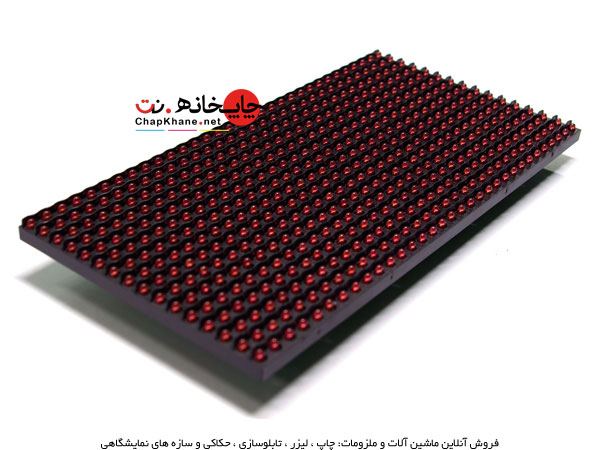
Types of LED module blocks
- Module block 706 and 806 – premium and bright / in different colors
- P10 Green Monochrome Module
- P10 full color module
- P10 white monochrome module
- P10 V701C Silver Red Monochrome Module
- P10 V706 Red Monochrome Module
- Static RGB P16 full color module


Description
📅 Content updated on: 10/02/1403
P10 Green Monochrome Module
The LED flexible sign module, as the most important part in determining the specifications and quality of the LED flexible sign, should be given special attention by the consumer. In addition to having an acceptable quality level, Honar Trade LED flexible sign modules can be used in a wide range of flexible signs due to the variety of specifications. LED The table below is the specifications of the green monochrome flow board module.
| Specifications of P10 green single color LED module | ||
| 1G P10 Outdoor Module | ||
| Row | Description | Specifications |
| 1 | Length | 32 cm |
| 2 | Width | 16 cm |
| 3 | Number of pixels | 512 |
| 4 | Panel resolution | Pix/SQM 10000 |
| 5 | Hub type | 12 |
| 6 | Type of drive | 1 to 4 scan |
| 7 | Brightness | 4500 CD/SQM |
| 8 | LED type | DIP 546 |
| 9 | Useful life | 10,000 hours |
| 10 | PCB name | V701C Silver |
The LED display module or LED display block or LED Display Module is one of the three main elements of LED display equipment.
In summary, these three elements are:
- LED Flowing Sign Module
- 5V power supply or switching power supply
- Flow control board card
In optical systems, the main color components are the three primary colors red, green, and blue (RGB), which are fundamentally different from the printing color system of cyan, magenta, yellow, and black (CMYK). Therefore, to produce most colors by light in a flowing panel, it is necessary that these three color components are present. It is clear that each module, depending on the presence of each of these components, has the ability to produce one color if there is one component (monochrome module), three colors if there are two components (tricolor module), and all colors if there are three components (full-color module).
In general, to introduce a module, it is necessary to define 6 main elements, which are:
- Color component type Flow chart module:Which indicates what color component is present in each pixel of the module. For this, three letters are used: R for red, G for green, B for blue. There are several other types of colors in monochrome modules, including white W, orange O – pink P
- Number of color components per pixel : In each module of a flowing board, in addition to the importance of the type of color components, their number in each component is also important. For example, a module with two red components per pixel is represented as a 2R module.
- Pixel spacing of the LED panel module The center-to-center distance of each pixel in a LED module is known as DOT PITCH, which is measured in millimeters and represents the resolution of the LED module. For example, a module with one red and one green component per pixel and a distance of 10 millimeters is shown as 1R1G P10.
- Type of drive Flow chart module: In fact, the type of drive indicates the time interval between each pixel of the LED module receiving the command from the controller card. This means that if all the pixels of a LED module receive commands from the control card at the same time, this is called static mode, which has the highest brightness of the module. The other mode is Refresh or Scan, in which the module receives the command linearly and consecutively from the controller card. For example, in a module with a width of 16 lines, the module can receive commands in 4 turns, so that first rows 1, 5, 9, and 13 receive the command, then rows 2, 6, 10, and 14, then 3, 7, 11, and 16, and finally rows 4, 8, 12, and 16. In this case, since the time interval between the rows is very short, the eye is not able to detect this time difference and sees the image uniformly. Refresh mode is named based on the number of rows that are instructed at a time relative to the total rows of the module. In the previous mode, given that 4 rows out of 16 are instructed at a time, it can be said that the module is 16/4 or, more precisely, 4/1, and is named as a 1 to 4 scan.
- Where the module is used: The flexible panel module is produced in three forms: indoor use, semi-outdoor use but away from moisture, and outdoor use.
- Hub type Input HUB : Based on data transmission standards, the hub module type can be one of the 8, 12, 40, and 75 modes, which is explained in the controller cards section.
Things you need to know before buying a full-color module:
- Definition of P10 full color module
- Full color module specifications
- A module needs to define 6 main elements
P10 full color module
The LED panel module, as the most important part in determining the specifications and quality of the LED panel, should be given special attention by the consumer. In addition to having an acceptable quality level, the LED panel modules of Honar Trade can be used in a wide range of LED panels due to the variety of specifications. The table below is the specifications of the full-color panel module.
Full color module specifications
| Row | Description | Specifications |
| 1 | Length | 16 cm |
| 2 | Width | 16 cm |
| 3 | Number of pixels | 256 |
| 4 | Panel resolution | Pix/SQM 10000 |
| 5 | Hub type | 75 |
| 6 | Type of drive | 1 to 4 scan |
| 7 | Brightness | 7500 CD/SQM |
| 8 | LED type | DIP 346 |
| 9 | Useful life | 10,000 hours |
| 10 | PCB name | – |
The LED display module or LED display block or LED Display Module is one of the three main elements of LED display equipment.
- LED Flowing Sign Module
- Flow control board card
- 5V power supply or switching power supply
In optical systems, the main color components are the three primary colors red, green, and blue (RGB), which are fundamentally different from the printing color system of cyan, magenta, yellow, and black (CMYK). Therefore, to produce most colors by light in a flowing panel, it is necessary that these three color components are present. It is clear that each module, depending on the presence of each of these components, has the ability to produce one color if there is one component (monochrome module), three colors if there are two components (tricolor module), and all colors if there are three components (full-color module).
A module needs to define 6 main elements:
- Color component type of the smooth panel module: Which indicates what color component is present in each pixel of the module. For this, three letters are used: R for red, G for green, B for blue. There are several other types of colors in monochrome modules, including white W, orange O– pink P
- Number of color components per pixel: In each module of a flowing board, in addition to the importance of the type of color components, their number in each component is also important. For example, a module with two red components per pixel is represented as a 2R module.
- Pixel spacing of the LED panel module: The center-to-center distance of each pixel in a LED module is known as DOT PITCH, which is measured in millimeters and represents the resolution of the LED module. For example, a module with one red and one green component per pixel and a distance of 10 millimeters is shown as 1R1G P10.
- Type of drive for the panel module: In fact, the type of drive indicates the time interval between receiving commands from each pixel of the LED module from the controller card. This means that if all pixels of a LED module receive commands from the control card at the same time, this is called static mode, which has the highest brightness of the module. The other mode is Refresh or Scan, in which the module receives commands linearly and consecutively from the controller card. For example, in a module with a width of 16 lines, the module can receive commands in 4 turns, so that first rows 1, 5, 9, and 13 receive commands, then rows 2, 6, 10, and 14, then 3, 7, 11, and 16, and finally rows 4, 8, 12, and 16. In this case, since the time interval between the rows is very short, the eye is not able to detect this time difference and sees the image uniformly. Refresh mode is named based on the number of rows that are instructed at a time relative to the total rows of the module. In the previous mode, given that 4 rows out of 16 are instructed at a time, it can be said that the module is 16/4 or, more precisely, 4/1, and is named as a 1 to 4 scan.
- Where the module is usedThe flexible panel module is produced in three forms: Indoor use, Semi-outdoor use but away from moisture, and Outdoor use.
- Input hub type HUB: Based on data transmission standards, the hub module type can be one of the 8, 12, 40, and 75 modes, which is explained in the controller cards section.
P10 white monochrome module
The LED flexible sign module, as the most important part in determining the specifications and quality of the LED flexible sign, should be given special attention by the consumer. In addition to having an acceptable quality level, Honar Trade LED flexible sign modules can be used in a wide range of flexible signs due to the variety of specifications. LED The table below is the specifications of the white monochrome flow board module.
| Specifications of P10 white single color LED module | ||
| 1W P10 Outdoor Module | ||
| Row | Description | Specifications |
| 1 | Length | 32 cm |
| 2 | Width | 16 cm |
| 3 | Number of pixels | 512 |
| 4 | Panel resolution | Pix/SQM 10000 |
| 5 | Hub type | 12 |
| 6 | Type of drive | 1 to 4 scan |
| 7 | Brightness | 4500 CD/SQM |
| 8 | LED type | DIP 546 |
| 9 | Useful life | 10,000 hours |
| 10 | PCB name | V701c Silver |
The LED display module or LED display block or LED Display Module is one of the three main elements of LED display equipment.
In summary, these three elements are:
- LED Flowing Sign Module
- 5V power supply or switching power supply
- Flow control board card
In optical systems, the main color components are the three primary colors red, green, and blue (RGB), which are fundamentally different from the printing color system of cyan, magenta, yellow, and black (CMYK). Therefore, to produce most colors by light in a flowing panel, it is necessary that these three color components are present. It is clear that each module, depending on the presence of each of these components, has the ability to produce one color if there is one component (monochrome module), three colors if there are two components (tricolor module), and all colors if there are three components (full-color module).
In general, to introduce a module, it is necessary to define 6 main elements, which are:
- Color component type Flow chart module:Which indicates what color component is present in each pixel of the module. For this, three letters are used: R for red, G for green, B for blue. There are several other types of colors in monochrome modules, including white W, orange O – pink P
- Number of color components per pixel : In each module of a flowing board, in addition to the importance of the type of color components, their number in each component is also important. For example, a module with two red components per pixel is represented as a 2R module.
- Pixel spacing of the LED panel module The center-to-center distance of each pixel in a LED module is known as DOT PITCH, which is measured in millimeters and represents the resolution of the LED module. For example, a module with one red and one green component per pixel and a distance of 10 millimeters is shown as 1R1G P10.
- Type of drive Flow chart module: In fact, the type of drive indicates the time interval between each pixel of the LED module receiving the command from the controller card. This means that if all the pixels of a LED module receive commands from the control card at the same time, this is called static mode, which has the highest brightness of the module. The other mode is Refresh or Scan, in which the module receives the command linearly and consecutively from the controller card. For example, in a module with a width of 16 lines, the module can receive commands in 4 turns, so that first rows 1, 5, 9, and 13 receive the command, then rows 2, 6, 10, and 14, then 3, 7, 11, and 16, and finally rows 4, 8, 12, and 16. In this case, since the time interval between the rows is very short, the eye is not able to detect this time difference and sees the image uniformly. Refresh mode is named based on the number of rows that are instructed at a time relative to the total rows of the module. In the previous mode, given that 4 rows out of 16 are instructed at a time, it can be said that the module is 16/4 or, more precisely, 4/1, and is named as a 1 to 4 scan.
- Where the module is used: The flexible panel module is produced in three forms: indoor use, semi-outdoor use but away from moisture, and outdoor use.
- Hub type Input HUB : Based on data transmission standards, the hub module type can be one of the 8, 12, 40, and 75 modes, which is explained in the controller cards section.
P10 V701C Silver Red Monochrome Module
The LED sign module, as the most important part in determining the specifications and quality of the LED sign, should be given special attention by the consumer. In addition to having an acceptable quality level, Honar Trade LED sign modules can be used in a wide range of signboards due to the variety of specifications. LEDThe table below is the specifications of the red monochrome flow board module.
| Specifications of P10 red single color LED module | ||
| 1R P10 Outdoor Module | ||
| Row | Description | Specifications |
| 1 | Length | 32 cm |
| 2 | Width | 16 cm |
| 3 | Number of pixels | 512 |
| 4 | Panel resolution | Pix/SQM 10000 |
| 5 | Hub type | 12 |
| 6 | Type of drive | 1 to 4 scan |
| 7 | Brightness | 3500 CD/SQM |
| 8 | LED type | DIP 546 |
| 9 | Useful life | 10,000 hours |
| 10 | PCB name | V701 C |
Flow chart module LED Or a block of flowing boards or LED Display Module It is one of the three main elements of the flow chart equipment.
In summary, these three elements are:
1. Flow chart module LED
2. 5V power supply or switching power supply
3. Flow control board card
In optical systems, the main color components are the three primary colors: red, green, and blue (RGB) that these components are the main difference with the printing color system Includes turquoise, purple, yellow and black (CMYK) have. Therefore, to produce most colors by light in a flowing panel, it is necessary that these three color components are present. It is clear that each module, depending on the presence of each of these components, has the ability to produce one color if there is one component (monochrome module), three colors if there are two components (tricolor module), and all colors if there are three components (full-color module).
In general, to introduce a module, it is necessary to define 6 main elements, which are:
· Color component type Flow chart module:Which indicates what color component is present in each pixel of the module. For this purpose, three letters are used R For red, G For green, B Used for blue. There are several other colors available in single-color modules, including white. W , orange O– Pink P
· Number of color components per pixel : In each module of a flowing sign, in addition to the importance of the type of color components, their number in each component is also important. For example, a module with two red components per pixel as a module 2R It is shown.
· Pixel spacing of the LED panel module Dot Pitch: The center-to-center distance of each pixel in the smooth panel module is defined by the word dot pitch. DOT PITCH It is known that it is in millimeters and represents the resolution of the display. For example, a module with one red and one green component per pixel and a distance of 10 millimeters is as follows: 1R1G P10It is shown.
· Type of drive Flow chart module: In fact, the type of drive indicates the time interval between each pixel of the LED module receiving commands from the controller card. This means that if all pixels of a LED module receive commands from the control card at the same time, this is called static mode, which has the highest brightness of the module. Another mode Refresh Or scan, in which case the module receives the command linearly and consecutively from the controller card. For example, in a module that is 16 lines wide, the module can receive the commands in 4 turns, so that first lines 1, 5, 9, and 13 receive the command, then lines 2, 6, 10, and 14, then 3, 7, 11, and 16, and finally lines 4, 8, 12, and 16. In this case, since the time interval between the lines being lit is very short, the eye is not able to detect this time difference and sees the image uniformly. Mode Refresh They are named based on the number of rows that receive instructions at a time relative to the total rows of the module. In the previous case, given that 4 rows out of 16 are received instructions at a time, we can say that the module is 16/4 or, more precisely, 4/1, and it is named as a 1 to 4 scan.
· Where the module is used: Flowing panel module in three forms, for indoor use Indoor And use outdoors but away from moisture. Semi-outdoor And for outdoor use Outdoor It is produced.
· Hub type Input HUB : Based on data transmission standards, the hub module type can be one of the 8, 12, 40, and 75 modes, which is explained in the controller cards section.
P10 V706 Red Monochrome Module
The LED sign module, as the most important part in determining the specifications and quality of the LED sign, should be given special attention by the consumer. In addition to having an acceptable quality level, Honar Trade LED sign modules can be used in a wide range of signboards due to the variety of specifications. LEDThe table below is the specifications of the red monochrome flow board module.
| Specifications of P10 red single color LED module | ||
| 1R P10 Outdoor Module | ||
| Row | Description | Specifications |
| 1 | Length | 32 cm |
| 2 | Width | 16 cm |
| 3 | Number of pixels | 512 |
| 4 | Panel resolution | Pix/SQM 10000 |
| 5 | Hub type | 12 |
| 6 | Type of drive | 1 to 4 scan |
| 7 | Brightness | 3500 CD/SQM |
| 8 | LED type | DIP 546 |
| 9 | Useful life | 10,000 hours |
| 10 | PCB name | V706 |
Flow chart module LED Or a block of flowing boards or LED Display Module It is one of the three main elements of the flow chart equipment.
In summary, these three elements are:
1. Flow chart module LED
2. 5V power supply or switching power supply
3. Flow control board card
In optical systems, the main color components are the three primary colors: red, green, and blue (RGB) that these components are the main difference with the printing color system Includes turquoise, purple, yellow and black (CMYK) have. Therefore, to produce most colors by light in a flowing panel, it is necessary that these three color components are present. It is clear that each module, depending on the presence of each of these components, has the ability to produce one color if there is one component (monochrome module), three colors if there are two components (tricolor module), and all colors if there are three components (full-color module).
In general, to introduce a module, it is necessary to define 6 main elements, which are:
· Color component type Flow chart module:Which indicates what color component is present in each pixel of the module. For this purpose, three letters are used R For red, G For green, B Used for blue. There are several other colors available in single-color modules, including white. W , orange O– Pink P
· Number of color components per pixel : In each module of a flowing sign, in addition to the importance of the type of color components, their number in each component is also important. For example, a module with two red components per pixel as a module 2R It is shown.
· Pixel spacing of the LED panel module Dot Pitch: The center-to-center distance of each pixel in the smooth panel module is defined by the word dot pitch. DOT PITCH It is known that it is in millimeters and represents the resolution of the display. For example, a module with one red and one green component per pixel and a distance of 10 millimeters is as follows: 1R1G P10It is shown.
· Type of drive Flow chart module: In fact, the type of drive indicates the time interval between each pixel of the LED module receiving commands from the controller card. This means that if all pixels of a LED module receive commands from the control card at the same time, this is called static mode, which has the highest brightness of the module. Another mode Refresh Or scan, in which case the module receives the command linearly and consecutively from the controller card. For example, in a module that is 16 lines wide, the module can receive the commands in 4 turns, so that first lines 1, 5, 9, and 13 receive the command, then lines 2, 6, 10, and 14, then 3, 7, 11, and 16, and finally lines 4, 8, 12, and 16. In this case, since the time interval between the lines being lit is very short, the eye is not able to detect this time difference and sees the image uniformly. Mode Refresh They are named based on the number of rows that receive instructions at a time relative to the total rows of the module. In the previous case, given that 4 rows out of 16 are received instructions at a time, we can say that the module is 16/4 or, more precisely, 4/1, and it is named as a 1 to 4 scan.
· Where the module is used: Flowing panel module in three forms, for indoor use Indoor And use outdoors but away from moisture. Semi-outdoor And for outdoor use Outdoor It is produced.
· Hub type Input HUB : Based on data transmission standards, the hub module type can be one of the 8, 12, 40, and 75 modes, which is explained in the controller cards section.
Static RGB P16 full color module
The LED flexible sign module, as the most important part in determining the specifications and quality of the LED flexible sign, should be given special attention by the consumer. In addition to having an acceptable quality level, Honar Trade LED flexible sign modules can be used in a wide range of flexible signs due to the variety of specifications. LED The table below is the specifications of the full-color Dot Patch 16 dynamic panel module.
| Specifications of P16 full color LED module | ||
| RGB P16 Outdoor Module | ||
| Row | Description | Specifications |
| 1 | Length | 25.6 cm |
| 2 | Width | 25.6 cm |
| 3 | Number of pixels | 256 |
| 4 | Panel resolution | Pix/SQM 3906 |
| 5 | Hub type | 40 |
| 6 | Type of drive | Static |
| 7 | Brightness | 9400 CD/SQM |
| 8 | LED type | DIP 346 |
| 9 | Useful life | 10,000 hours |
| 10 | PCB name | SD |
The LED display module or LED display block or LED Display Module is one of the three main elements of LED display equipment.
In summary, these three elements are:
- LED Flowing Sign Module
- 5V power supply or switching power supply
- Flow control board card
In optical systems, the main color components are the three primary colors red, green, and blue (RGB), which are fundamentally different from the printing color system of cyan, magenta, yellow, and black (CMYK). Therefore, to produce most colors by light in a flowing panel, it is necessary that these three color components are present. It is clear that each module, depending on the presence of each of these components, has the ability to produce one color if there is one component (monochrome module), three colors if there are two components (tricolor module), and all colors if there are three components (full-color module).
In general, to introduce a module, it is necessary to define 6 main elements, which are:
- Color component type Flow chart module:Which indicates what color component is present in each pixel of the module. For this, three letters are used: R for red, G for green, B for blue. There are several other types of colors in monochrome modules, including white W, orange O – pink P
- Number of color components per pixel : In each module of a flowing board, in addition to the importance of the type of color components, their number in each component is also important. For example, a module with two red components per pixel is represented as a 2R module.
- Pixel spacing of the LED panel module The center-to-center distance of each pixel in a LED module is known as DOT PITCH, which is measured in millimeters and represents the resolution of the LED module. For example, a module with one red and one green component per pixel and a distance of 10 millimeters is shown as 1R1G P10.
- Type of drive Flow chart module: In fact, the type of drive indicates the time interval between each pixel of the LED module receiving the command from the controller card. This means that if all the pixels of a LED module receive commands from the control card at the same time, this is called static mode, which has the highest brightness of the module. The other mode is Refresh or Scan, in which the module receives the command linearly and consecutively from the controller card. For example, in a module with a width of 16 lines, the module can receive commands in 4 turns, so that first rows 1, 5, 9, and 13 receive the command, then rows 2, 6, 10, and 14, then 3, 7, 11, and 16, and finally rows 4, 8, 12, and 16. In this case, since the time interval between the rows is very short, the eye is not able to detect this time difference and sees the image uniformly. Refresh mode is named based on the number of rows that are instructed at a time relative to the total rows of the module. In the previous mode, given that 4 rows out of 16 are instructed at a time, it can be said that the module is 16/4 or, more precisely, 4/1, and is named as a 1 to 4 scan.
- Where the module is used: The flexible panel module is produced in three forms: indoor use, semi-outdoor use but away from moisture, and outdoor use.
- Hub type Input HUB : Based on data transmission standards, the hub module type can be one of the 8, 12, 40, and 75 modes, which is explained in the controller cards section.
Reviews (1)

Get price list